10 wichtige Fragen, die Sie sich vor dem Kauf von industriellen Strukturverpackungen stellen sollten
April 22, 2026
10 wichtige Fragen, die Sie sich vor dem Kauf von industriellen Strukturverpackungen stellen sollten
Dieser Leitfaden bietet Einkaufsleitern, Betriebsingenieuren und Projektleitern, die mit der Auswahl von industriellen Strukturverpackungen betraut sind, einen strategischen Rahmen. Er geht über grundlegende Spezifikationen hinaus und skizziert zehn entscheidende Fragen, die beantwortet werden müssen, um sicherzustellen, dass Ihre Investition die betrieblichen Ziele erreicht – sei es bei einem Neubau oder einer bestehenden Anlage. Nachrüstung einer Chemieanlage.
Entscheidend ist, dass der Wert jeder Frage durch Beispiele aus der realen Welt untermauert wird. Fallstudie zu strukturiertem Packen Erkenntnisse, die aufzeigen, wie gezielte Untersuchungen zu konkreten Ergebnissen wie Kapazitätserhöhungen, erfolgreicher Engpassbeseitigung und erheblichen Energieeinsparungen führen. Energiesparende Verpackung.
Mit dieser disziplinierten Vorgehensweise können Sie den Kauf einer Komponente in eine wertorientierte Partnerschaft verwandeln, Risiken minimieren und eine Rendite garantieren.
Die 10 wichtigsten Fragen für eine strukturierte Verpackungsbeschaffung
1
Was sind die spezifischen Trennungsaufgaben und die Ziel-Leistungskennzahlen (KPIs)?
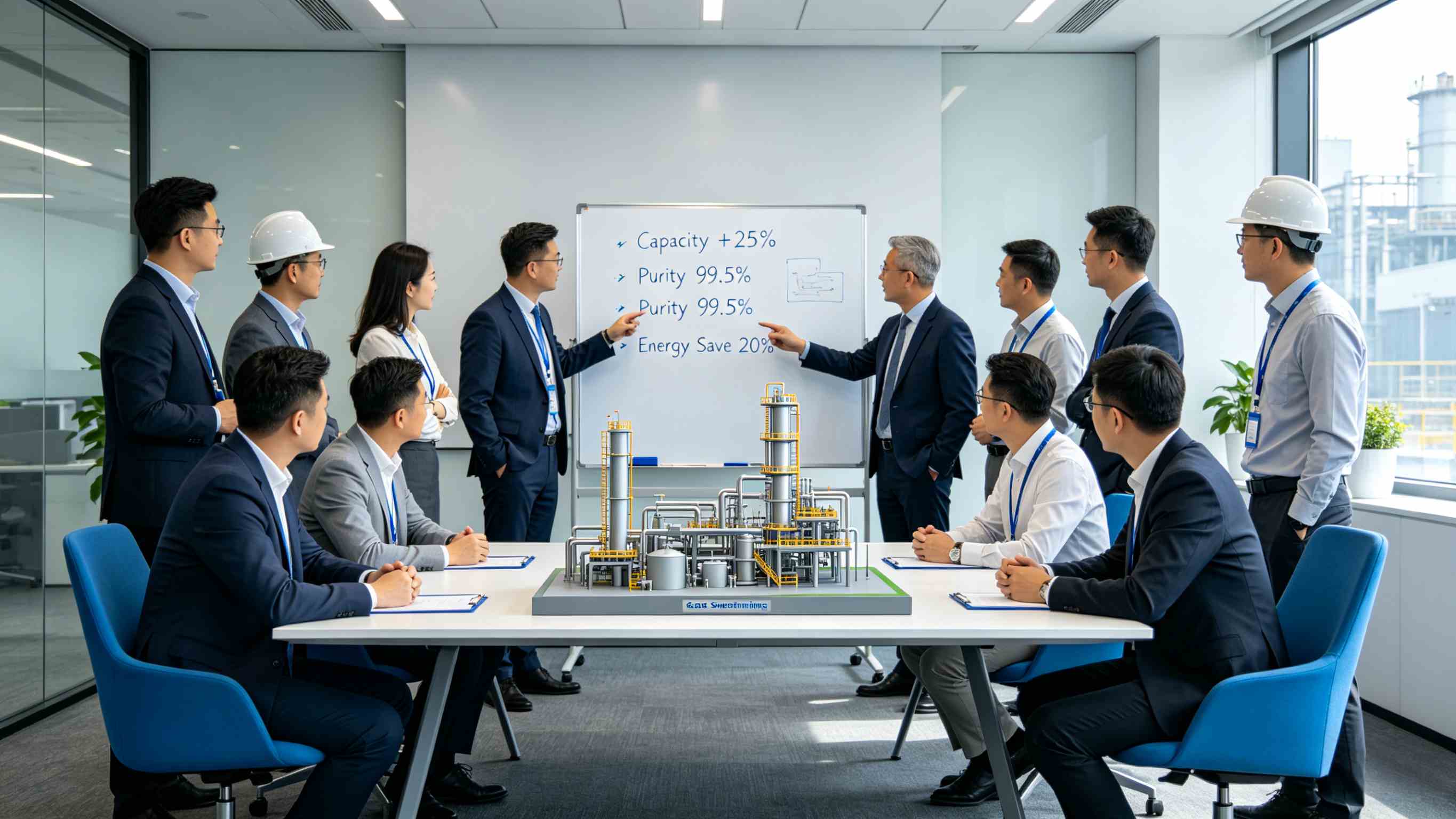
Beginnen Sie niemals mit dem Produkt; beginnen Sie mit dem Prozessziel. Definieren Sie klar, ob Ihr Hauptziel höhere Reinheit, erhöhter Durchsatz, reduzierter Energieverbrauch oder eine Kombination davon ist. Zum Beispiel in einem kürzlich durchgeführten Nachrüstung einer Chemieanlage Für eine Erdgasaufbereitungsanlage im Nahen Osten bestand der Leistungsindikator (KPI) darin, die CO-Konzentration zu erhöhen.2 Die Abscheidekapazität konnte um 25 % gesenkt werden, ohne die Säulenhülle zu verändern.
Einblick in die Fallstudie: Durch die Fokussierung auf diese Aufgabe wählte das Ingenieurteam eine hocheffiziente strukturierte Packung mit optimierter Geometrie, die die Grenzflächenfläche maximierte und somit das Kapazitätsziel erfolgreich erreichte. Klar definierte KPIs sind die Grundlage für eine effektive Verpackungsauswahl.
2
Was sind die vollständigen Betriebsbedingungen und ihre Bereiche?
Druck, Temperatur und Gas-/Flüssigkeitsdurchflussraten (sowohl Auslegungs- als auch Regelbereichsverhältnisse) bestimmen die mechanische und hydraulische Auslegung der Packung. Fallstudie zu strukturiertem Packen Ein Beispiel dafür ist eine europäische Methanolanlage: Dort wurden variable Zufuhrraten verwendet.
Einblick in die Fallstudie: Der Lieferant empfahl eine Packungsart, die auch bei einer Teillast von 50 % eine hohe Effizienz beibehält, Fehlverteilungen verhindert und einen stabilen Betrieb über den gesamten Bereich gewährleistet, was für einen flexiblen Anlagenbetrieb von entscheidender Bedeutung ist.
3
Wie beeinflussen die chemischen Eigenschaften der Prozessflüssigkeiten die Materialwahl?
Die chemische Beschaffenheit Ihrer Ströme – Korrosivität, Neigung zu Ablagerungen, Vorhandensein von Feststoffen oder Polymerisationsrisiko – ist von entscheidender Bedeutung. Für eine Schwefelsäureanlage NachrüstungStandardmäßiger Edelstahl reichte nicht aus.
Einblick in die Fallstudie: Die Lösung bestand in der Herstellung von Packungen aus einer hochwertigen Legierung mit einer speziellen Oberflächenbehandlung, um Korrosion zu widerstehen und Ablagerungen zu minimieren, wodurch die Laufzeiten drastisch verlängert wurden. Das richtige Material ist keine Option, sondern eine Notwendigkeit für Zuverlässigkeit.
4
Welche Effizienz- (HETP) und Kapazitätsanforderungen gelten?
Sie müssen die theoretischen Anforderungen an die Trennstufenhöhe (HETP – Height Equivalent to a Theoretical Floor) mit der Dampfkapazität der Kolonne in Einklang bringen. Hocheffiziente Füllkörper weisen eine niedrigere HETP auf, können aber zu Kapazitätseinbußen führen.
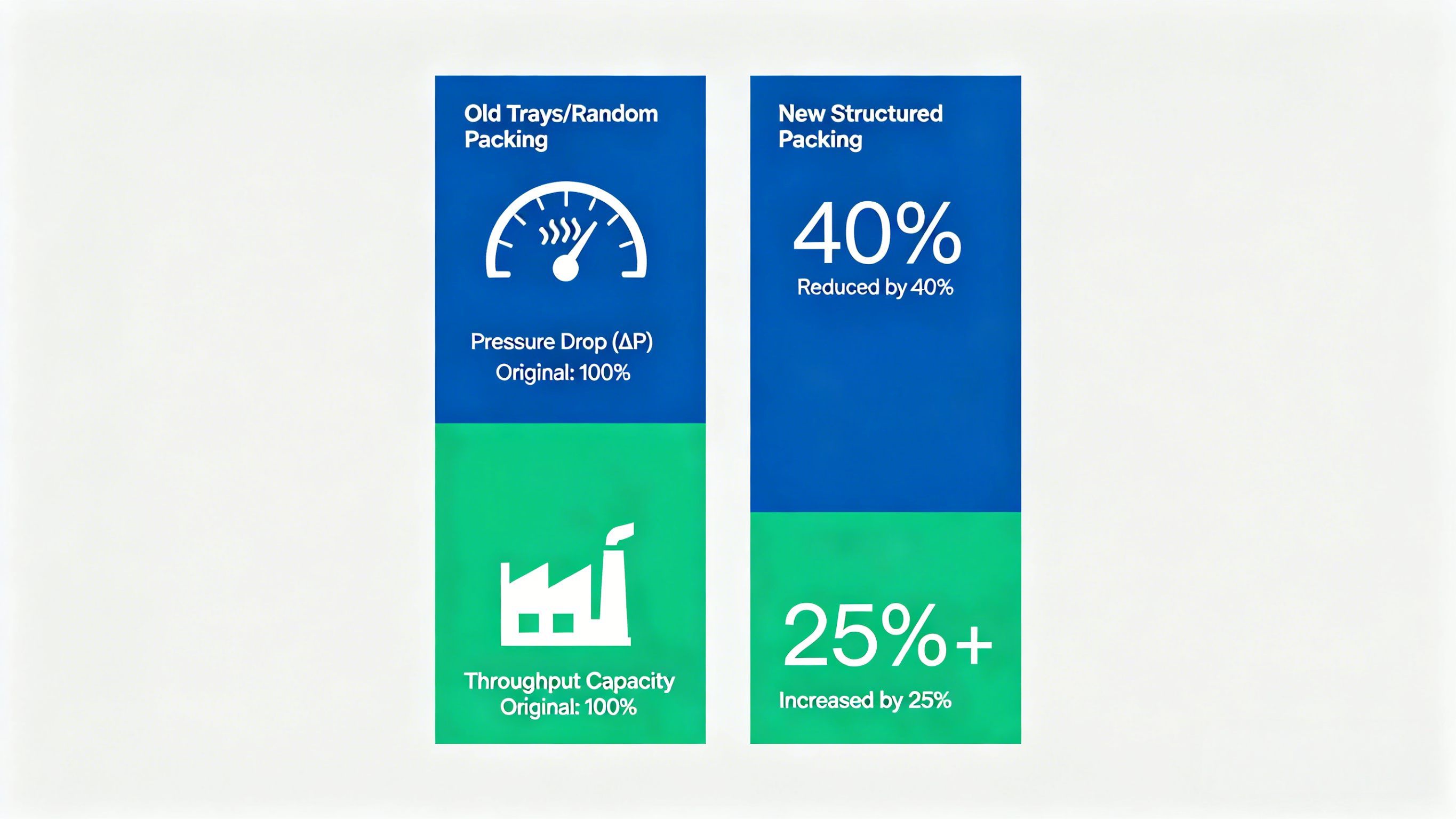
Einblick in die Fallstudie: Ein Energiesparende Verpackung Eine Erfolgsgeschichte stammt aus einem Projekt zur Engpassbeseitigung in einer Raffinerie. Durch den Wechsel von älteren Siebböden zu einer neuen Generation strukturierter Packungen erreichte die Raffinerie die erforderliche Trenneffizienz bei geringerer Betthöhe, wodurch Platz für zusätzliche Kapazität geschaffen und gleichzeitig der Druckverlust reduziert wurde.
5
Wie hoch ist der zulässige Druckverlust und wie wirkt sich dieser auf die Energiekosten aus?
Dies ist das Herzstück des Energiesparende Verpackung Argument: Der Druckabfall korreliert direkt mit dem Energieverbrauch des Kompressors bzw. Verdampfers. Fordern Sie daher immer eine detaillierte hydraulische Leistungskennlinie an.
Einblick in die Fallstudie: In einem dokumentierten FallstudieEin petrochemisches Unternehmen ersetzte in einer Destillationskolonne die Schüttpackung durch eine strukturierte Packung mit geringem Druckverlust. Das Ergebnis war eine 22 % Reduzierung des Dampfverbrauchs im Verdampferund amortisiert die Investition in weniger als 14 Monaten. Die wahren Kosten des Packens verstecken sich in Ihren Strom- und Heizkostenabrechnungen.
6
Welche geometrischen Einschränkungen gelten für die Säule (Durchmesser, Höhe, Zugänglichkeit)?
Für Nachrüstung einer Chemieanlage Bei Projekten sind Sie oft an bestehende Säulenabmessungen gebunden. Ein erfahrener Lieferant führt sorgfältige Modellierungen durch, um die optimale Packungsgröße und das optimale Verteilsystem zu ermitteln.
7
Welche langfristigen Wartungs-, Reinigungs- und Verschmutzungsanforderungen gibt es?
Besprechen Sie die Inspektionsfreundlichkeit, die Reinigungsmethoden und die zu erwartenden Wartungsintervalle. Eine gute Verpackungskonstruktion sollte Ausfallzeiten minimieren.
8
Was sind die Gesamtbetriebskosten (Total Cost of Ownership, TCO), nicht nur der Anschaffungspreis?
Die billigste Verpackung kann die teuerste sein. Berechnen Sie die Gesamtbetriebskosten (TCO), indem Sie Kaufpreis, Installation und weitere Kosten berücksichtigen. EnergieeinsparungenWartung und erwartete Lebensdauer.
9
Können Sie detaillierte Fallstudien oder Referenzen von einer ähnlichen Anwendung bereitstellen?
Das ist nicht verhandelbar. Ein seriöser Lieferant sollte über ein Portfolio verfügen von Fallstudie zu strukturiertem Packen Unterlagen.
10
Welchen technischen Support und Kundendienst bieten Sie an?
Die Partnerschaft endet nicht mit der Lieferung. Erkundigen Sie sich nach Unterstützung bei der Prozesssimulation, detaillierter Planung, Installationsüberwachung und Leistungsgarantien.
Häufig gestellte Fragen (FAQ)
Frage 1: Was ist der häufigste Fehler beim Kauf von strukturierten Verpackungen?
A: Der häufigste Fehler besteht darin, sich ausschließlich auf den Anschaffungspreis anstatt auf die Gesamtbetriebskosten (TCO) zu konzentrieren. Eine billigere Verpackung kann zu höheren Energiekosten und häufigen Ausfallzeiten führen.
Frage 2: Wie schnell kann ich mit einer Amortisation der Investition in energiesparende Verpackungen rechnen?
A: Am meisten Nachrüstung einer Chemieanlage Die Projekte erzielen einen ROI innerhalb von 12-24 Monaten durch eine Reduzierung des Dampf- oder Stromverbrauchs um 15-25%.
Frage 3: Kann eine strukturierte Packung in eine bestehende Kolonne nachgerüstet werden?
A: Ja, in den meisten Fällen. Spezialisierte Lieferanten sind auf die Auslegung von Packungen für feste Säulenbedingungen spezialisiert, wie zahlreiche Beispiele zeigen. Fallstudie zu strukturiertem Packen Berichte.
Frage 4: Ist strukturierte Packung für Fouling- oder Korrosionsprozesse geeignet?
A: Ja, bei geeigneter Material- und Geometrieauswahl. Fallstudien zeigen, dass strukturierte Packungen unter rauen Bedingungen eine überlegene Lebensdauer bieten können.
Frage 5: Wie kann ich die Leistungsangaben von Lieferanten überprüfen?
A: Detaillierte Anfrage Fallstudie Dokumentation und bestehen Sie auf einer klaren Leistungsgarantie, die auf einer strengen Prozesssimulation basiert.
Sichern Sie sich Ihr Testkit für strukturierte Verpackungen
Sind Sie bereit, diese 10 Fragen auf Ihr Projekt anzuwenden? Kontaktieren Sie uns für einen detaillierten TCO-Rechner, eine technische Checkliste und weitere relevante Informationen. Fallstudien zu strukturierten Verpackungen für Ihre Branche.
Manager Qiu: +86 18507999558
E-Mail: info@pxfangxing.com
Webseite: http://www.pxfangxing.com/
Gestalte dein nächstes Nachrüstung einer Chemieanlage ein Maßstab für den Erfolg mit FXSINO Energiesparende Verpackung Lösungen.
Wenn Sie an unseren Produkten interessiert sind und weitere Einzelheiten erfahren möchten, hinterlassen Sie bitte hier eine Nachricht. Wir werden Ihnen so schnell wie möglich antworten.












 Adresse
: Intersection of Jinguang Avenue and Chongqing Middle Road, Anyuan Industrial Park, Anyuan District, Pingxiang City, Jiangxi
Adresse
: Intersection of Jinguang Avenue and Chongqing Middle Road, Anyuan Industrial Park, Anyuan District, Pingxiang City, Jiangxi Tel
:
Tel
:  Email
:
Email
:  WhatsApp
:
WhatsApp
:  IPv6-Netzwerk unterstützt